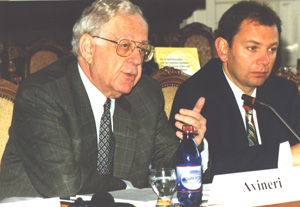
Showing posts with label Shlomo Avineri. Show all posts

Thursday, September 9, 2010

An article by Shlomo Avineri right after the rejection of the Annan Plan by Greek Cypriots in April 2004

From Fanoulla Argyrou's archives, an article by Professor Shlomo Avineri, written in 2004, right after the rejection of the Annan Plan by the Greek Cypriots. As Mrs Argyrou noted, Professor Avineri was one of the very very few foreign writers to explain to the world why we the Greek Cypriots were justified in rejecting the "Annan Plan". And said that "... In a united Europe, Greek Cypriots would not have freedom of movement in their own country - they would be ghettoed"..


article in "Financial Times"
28 April, 2004
by Shlomo Avineri


The Greek Cypriots' overwhelming rejection of the United Nations plan for the reunification of Cyprus should not come as a surprise. In the international media, the plan by Kofi Annan, UN secretary-general, had been presented as a fair-minded and well-intentioned compromise. The Greek Cypriots would regain some territory and a "Swiss-like federation" would reunify the island.

But this is not the way it looked to most Greek Cypriots in the south. To them it appeared that the UN and the European Union were bent on legitimising at least some of the consequences of the Turkish invasion of 1974, because the EU wanted to take the Cyprus issue off the table in order to facilitate negotiations on Turkey's accession to the EU.

Although the Annan plan in its various versions - the last one filled 9,000 pages - has not been fully translated into either Greek or Turkish, most of its outlines were, of course, known. But while outside observers focused mostly on the territorial and constitutional aspects suggested by the plan, for most Greek Cypriots the plan not only failed to answer their concerns but also seemed to be contrary to both UN and EU norms and values.

While some Turkish-occupied territory would be returned to Greek Cypriot rule, the contours of the Turkish Cypriot region would still reflect the outcome of Turkey's military invasion of 1974. Only half of the 200,000 Greek Cypriot refugees uprooted by the Turkish invasion would be able to return to their former homes. The rest would not be able to return, or be entitled to adequate compensation.

Most of the Anatolian Turks who have been settled in the north by the Turkish occupation authorities would remain. Turkish forces would also stay in the north until Turkish accession to the EU - an arrangement the Greek Cypriots would consider an infringement of their sovereignty. The UN and the EU, which, justly, oppose the Israeli occupation of the West Bank and Jewish settlements in the occupied territories, appeared to reward Turkish occupiers and settlers in the Cyprus case.

Last but not least, Greek Cypriots would not be able to move freely or settle in the Turkish north. This last prohibition rattled Greek Cypriots most because it meant that in a united Europe, where every EU citizen would be more or less free to take up residence and work in the Turkish part of Cyprus, Greek Cypriots would not have freedom of movement in their own country. In a way, the Greek Cypriots would have been ghettoised.

The failure to win approval for the Annan plan has wider ramifications. It shows that there are limits to what massive international pressure can accomplish when at least one of the participants in a dispute feels that its concerns have not been adequately dealt with.

Even well-intentioned plans cannot be first worked out by outside powers and then rammed down the throats of recalcitrant parties, whether in Cyprus or Bosnia, Kosovo or Kashmir, or in the Israeli-Palestinian conflict. When there is no local political will, outside pressure is not strong enough to achieve a workable solution. In such cases, conflict management is preferable to unrealistic outside schemes for conflict resolution.

The Greek part of Cyprus will enter the EU on May 1 under difficult conditions. Much wisdom and restraint will now be needed from both the EU and the Greek Cypriots. The EU, while obviously disappointed, should respect the sovereign will of the Greek Cypriot majority. The referendum, after all, was suggested by the international community and the EU expressed willingness to accept the Greek part of Cyprus even if reunification was not achieved by the accession date. To be vindictive now against the new member - Cyprus, albeit truncated - would be a political mistake and a moral failure on the part of the EU.

As for the Greek Cypriots, they should be careful not to translate their decision into triumphalism. Specifically, they should not view their successful accession to the EU as a licence for trying to bar EU negotiations with Turkey about future membership. On the contrary, like the Greek government, they should now advocate and support EU membership for Turkey.

This would be not only be magnanimous and politically astute, it might also be the only way towards a united Cyprus in the future, under conditions more acceptable to the Greek Cypriots and more in tune with international norms and values.

Shlomo Avineri: Turkey's frontline foreign policy

Journalist Fanoulla Argyrou comments: I would be grateful if you would kindly circulate the following comment to all those who received the article below. A very good analysis of Turkish intentions by Professor Avineri, as always. Back in April 2004 Professor Shlomo Avineri published an article in the Financial Times in London (on 28th April 2004 to be exact) titled "Realities behind the failure over Cyprus". He was one of the very very few foreign writers to explain to the world why we the Greek Cypriots were justified in rejecting the "Annan Plan". And said that "... In a united Europe, Greek Cypriots would not have freedom of movement in their own country - they would be ghettoed"...


by Shlomo Avineri, Professor of Political Science at Hebrew University, Director-General of Israel's Foreign Ministry in the first cabinet of Yitzhak Rabin
article in "In Depth", Volume 7, Issue. 4
Cyprus Center for European and International Affairs, University of Nicosia


A few months before he became Turkey’s foreign minister, Ahmet Davutoglu, then Prime Minister Recep Tayyip Erdogan’s chief adviser, met with a group of Middle Eastern academics and policy experts, including Arabs and Israelis. With his academic background and immense erudition, he succeeded in painting, on a wide canvass, the new directions of Turkey’s policies under the Justice and Development Party (AKP) leadership.
 
By then, it had become clear that Turkey’s road to the European Union had been closed, somewhat rudely, owing mainly to combined German and French pressure. But those who expected Islamist fire and brimstone from Davutoglu were deeply disappointed.
 
What was articulated was a levelheaded and sophisticated exposé, seldom heard from policymakers: it was thoughtful, honest, and breath-taking. It was also a clear departure from the conventional foreign-policy straightjacket devised by Kemal Ataturk, which had for decades forced Turkish diplomacy into the Procrustean bed of 1920’s-style integral nationalism.
 
Davutoglu began conventionally, declaring that Turkey’s geopolitical situation would always dictate the country’s foreign policy. Then came the bombshell: contrary to the conventional Kemalist view of the One and Indivisible Turkish Nation, Davutoglu referred to what everyone has known since modern Turkey was created: the country has more Azeris than Azerbaijan, more people of Albanian origin than live in Albania, more people of Bosniak origin than live in Bosnia, and more Kurds than in Iraqi Kurdistan.
 
This reality, Davutoglu maintained, means that violence and instability in Turkey’s immediate neighborhood threatens to spill into Turkey itself, and regional external conflicts can easily become internally disruptive. Hence the credo of Turkish foreign policy should be “zero conflicts with our neighbors and in our neighborhood.”
 
This, he explained, was the reason that Turkey was trying to find an accommodation with Armenia. It justified Turkey’s policy vis-à-vis the Kurdish Regional Government in Northern Iraq, its involvement in Bosnia and in Kosovo, its rapprochement with Syria, and also its attempt to mediate between Syria and Israel.
 
Turkey, he argued, is neither pro-Israeli nor pro-Syrian: it seeks an Israeli-Syrian accommodation in order to add another building block to regional stability. All these steps are taken by the AKP government because it is in Turkey’s interest, given not only its geopolitical position, but also its unique multi-ethnic structure (he didn’t use that terminology, though the implication was clear).
 
Since then (Davutoglu became Foreign Minister in May 2009), much of what Turkey has done can be explained as being in line with this “zero conflicts” theory, including a slightly more nuanced policy on the Cyprus issue. Yet recent developments suggest that, if this policy is pushed to its limits, it stumbles on its own premises.
 
One can well understand a Turkish policy of trying to defuse tensions with Iran over that country’s nuclear program. But the joint Iranian-Brazilian-Turkish initiative goes beyond such a policy.
 
Brazil’s President Luiz Inácio Lula da Silva may have stepped on a hornets’ nest, owing to his unfamiliarity with regional policies and his general anti-Yanqui sentiments. Erdogan must have known that, by trying in this way to shield Iran, he is opening a wider chasm with the EU – and obviously with the United States. Opposing new sanctions against Iran in the Security Council further alienated Turkey from both the EU and the US. This does not sit well with a “zero conflict” policy.
 
The same can be said about the shrill tone that Turkey, and Erdogan himself, has recently adopted vis-à-vis Israel. Walking off the stage at Davos during a round-table debate with Israel’s President Shimon Peres might have gained Erdogan points in the Arab world, which has historically viewed Turkey with the suspicion owed to the old imperial ruler. But the vehemence with which he lashed out at Israel during the Gaza flotilla crisis obviously went far beyond (justified) support for beleaguered Palestinians and (equally justified) criticism of the messy way in which Israel dealt with an obviously difficult situation.
 
While gaining support on the so-called Arab street, and perhaps upstaging Iranian President Mahmoud Ahmedinejad in the role of a modern Commander-of-the-Faithful, Erdogan’s policy and behavior have shocked not only Israelis, but also moderate Arab leaders in Egypt, Saudi Arabia, Jordan, and some of the Gulf states.
 
For many years, the AKP appeared to many in the region and elsewhere as a model for a democratic party with Islamic roots. But by supporting Hamas, Erdogan has allied Turkey with the most disruptive and extremist fundamentalist force in the Muslim Arab world – an organization that has its origins in the Muslim Brotherhood, the arch-enemy of all Arab regimes in the region (including, of course, Syria).
 
Since Erdogan is a critic of Israel, Arab rulers cannot say this openly. But Arab governments – and their security services – are beginning to ask themselves whether Turkey’s policies will undermine whatever internal stability their states possess.
 
This is the exact opposite of a genuine “zero conflict” policy that aims to minimize tensions and enhance stability. Turkey now finds itself, through its alliance with Iran and support for Hamas, rushing headlong into a series of conflicts – with Europe, the US, Israel, and moderate Arab regimes that have survived Iranian Shia fundamentalism but may now feel threatened by a neo-Ottoman Sunni foreign policy.
 
Turkey is thus emerging not as a regional mediator, equidistant from contending local players, but as an assertive, if not aggressive, regional power aiming for hegemony. Far from avoiding conflicts and mediating existing tensions, Turkey under the AKP appears intent on stoking new conflicts and creating new frontlines.