Showing posts with label articles. Show all posts

Sunday, September 19, 2010

Letter to members of the US Senate: Mat Bryza’s pro-Turkish devotion incompatible with human rights principles

We copy an open letter of veteran journalist, author and researcher Fanoulla Argyrou to the members of the US Senate, regarding the possible nomination of Matthew Bryza. Please distribute this letter to blogs and social networking sites.


Mat Bryza’s pro-Turkish devotion incompatible with human rights principles

Honourable Members of the United States Senate,

We have heard that the US Senate Foreign Relations committee chairman John Kerry, in response to a request by Senator Barbara Boxer, has postponed the committee vote on the nomination of US Ambassador to Azerbaijan designate Matt Bryza.

We welcome this move and hope that enough time will be allowed and enough research will go into the preliminary work needed to establish the suitability or not of Mr. Bryza to this post.

We remember Mr. Bryza very well and his statements during 2006 when he toured our area.

In his July 21, 2006 press conference, Matt Bryza responded to a question from a Turkish reporter from the Anatolia News Agency asking "what does the U.S. Government plan to help these people [Turkish Cypriots] end their isolation?"

Mr. Bryza responded "that we have done a number of things. We are providing $30.5 million in assistance to the Turkish Cypriot community. So we are already actively working to end the isolation of Turkish Cypriots-or to ease the isolation of Turkish Cypriots."

That was an insult to us Greek Cypriots, victims of a brutal Turkish invasion and continued occupation of half of our country Cyprus, a member of the UN and the EU. The Turkish Cypriots are not in any isolation whatsoever. That is a fabricated myth by Turkish propaganda. The Cyprus issue is not “the isolation of the Turkish Cypriots” but the fact that Turkey invaded Cyprus in 1974 and still holds under occupation half of a sovereign country.

The majority of Turkish Cypriots supported and welcomed the Turkish invading forces and joined them in their invasion against us the Greek Cypriots. To this day they condone Turkey in her violations of our human rights. It is us the Greek Cypriots who are isolated in that since the Turkish invasion in 1974 for 36 years Turkey and the Turkish Cypriots do not allow us to return to our land and properties. The Turks, Turkish Cypriots and the imported Turkish Anatolian population of settlers (purposely imported by Turkey in order change the demography of the occupied area and fill in the gap she created by the forceful uprooting of us the 200,000 Greek Cypriot refugees) are using however our stolen properties without our permission.

In total violation of our human rightsThe Turkish Cypriots enjoy the benefits of “both worlds”. Unlike us the victims and uprooted Greek Cypriot refugees, are free to travel anywhere in Cyprus, have been issued passports of the Republic of Cyprus, identity cards, they travel thus as citizens of the EU anywhere and their children enter European universities, they enjoy free medical, they come every day to the free part and work and get paid without paying taxes, whereas we the Greek Cypriots have to pay for our health cover [see APPENDIX I]. They are paid pensions, welfare, and all the benefits as citizens of the Republic of Cyprus without paying a penny in taxes and obligations. We the Greek Cypriots have in fact become second class citizens in our own country because it us the Greek Cypriots who subsidise them!

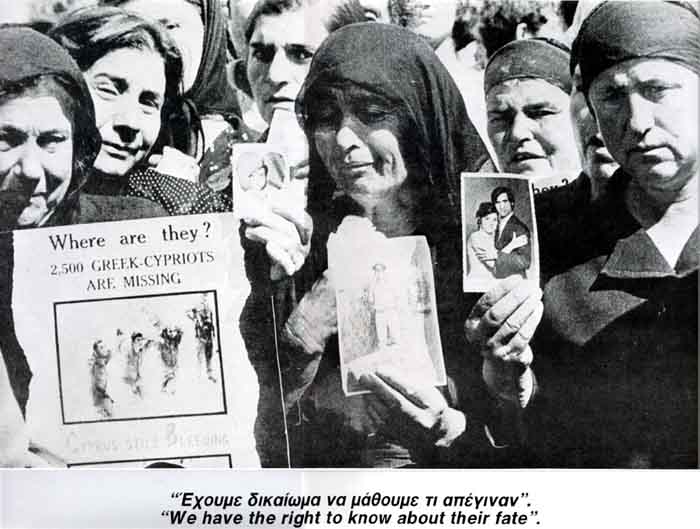
Furthermore Turkey in 1974 has murdered thousands of Greek Cypriots, 1619 are still missing presumed murdered as well and Turkey still does not reveal the whereabouts of these people in order relieve their families of the misery of waiting and dying without knowing what happened to their loved ones.

The Turkish invading army raped well over 800 Greek Cypriot women of all ages. The actual number to be precise reaches 2,000 and the 800 number represents those who had abortions.

At a press conference on July 21, 2006 on his return from a ten day trip to Turkey, Greece and Cyprus, in response to a question on the status of the Annan Plan and whether it's off the table, he stated:

"I would just repeat what I said, that the basic ideas that are-that became known as the Annan Plan reflect wisdom and hard work and a spirit of fairness, I would argue."

The Annan Plan was a monstrosity of the worst kind that provided Turkey 99% of all her demands over Cyprus i.e. giving her the control of the whole island on a platter. (Statement of admission by Turkish veteran journalist M.A. Birand). That plan excluded the 200,000 Greek Cypriots from returning to their homes, was that American “wisdom” and “fairness”? That plan opened Turkey an avenue to turkify the island in only few years after that. The people of Cyprus rejected that plan during the referendum on 24 April 2004. 76% of the Greek Cypriots rejected it and if one separates the vote of the illegal settlers from those of the Turkish Cypriot votes will find that even the indigenous Turkish Cypriots rejected that apartheid solution. Which favoured Turkey and only Turkey.

Mr. Bryza in his July 21 2006 statement found “wisdom” in it, “hard work” and “spirit of fairness”. Well, wisdom and fairness are two things that plan definitely did not reflect. What Mr. Bryza’s statement reflected though was his pro-Turkish stance which relates to his undisputable conflict of interest which stretches to his Turkish contacts. Starting from his Turkish born wife who is a major producer of Turkish invasion denial propaganda over the years.

Mr. Bryza is considered a major asset for Turkey but not for America.

We hope the Senate will use adequate judgement in taking the proper and right decision in respect and protection of the principles of human rights. To protect the victims and not those who offend.

Yours sincerely,

Fanoulla Argyrou 
Refugee from occupied Nicosia, Cyprus. 
London

APPENDIX I
According to information provided by the Cyprus Press and Information Office of the Republic of Cyprus Christofias Government up until December 2009 had given the Turkish Cypriots 167,28 million Euros! (And that is only from the present Government)

Break down figures:
22,62 million Euros for medical services
117,9 million Euros in social benefits
1,22 million Euros for child benefits and student grants
9,25 million Euros for agricultural purposes
4,35 million Euros for education
4,22 million Euros for electricity supply to the occupied
0,26 million Euros for telecommunications
7,46 million Euros in looking after the Muslim places of worship and houses in the free part of Cyprus, the Turkish language department at the Cyprus Broadcasting Corporation and retaining the check points.

Monday, September 13, 2010

Turkish racial policies and the forgotten islamist pogrom of 1955


source: FrontPage Magazine
date: 24 May 2005
by Alyssa A. Lappen


For 50 years, historians, diplomats and state department officials have touted Mustafa Kemal Ataturk as a great secular leader in a predominantly Muslim region, whose policies modernized and democratized Turkey, shaping it into a Western-style state. But Ataturk was western only insofar as he implemented the Turkification of Gobineau, wherein he substituted the Turks for the Aryans, whose ideology had terrible results in the rise of European Nazism. Regardless, in 1955, barely 17 years after the dictator's death, a little-known pogrom, driven primarily by Islamic fanaticism, targeted the Greek population of Istanbul, with the intent of driving non-Muslims from Turkey. 

From 1950 to 1960 Turkey experienced a profound reawakening of Islam, which the government and Demokrat Parti (DP) of Prime Minister Adnan Menderes both exploited and encouraged. Today, the policies Turkey set in motion in that pogrom remain in sw

According to Speros Vryonis Jr.'s landmark new study, The Mechanism of Catastrophe, the September 1955 government-orchestrated pogrom against the Greek Orthodox community “included the systematic destruction of the majority of its churches,” monasteries and cemeteries. Published this month by Greekworks.com, the work subtitled The Turkish Pogrom of September 6-7, 1955, and the Destruction of the Greek Community of Istanbul shows that riots which destroyed 4,500 Greek homes, 3,500 businesses, 90 religious institutions and 36 schools in 45 distinct communities, resulted not only from “fervid chauvinism, or even [from] the economic resentment of many impoverished rioters, but [from] the profound religious fanaticism in many segments of Turkish society.”

American, British and Greek diplomats all agreed that the violence was “indicative of religious fanaticism,” a fact with which even some Turkish commentators concurred.

A towering intellect and scholar of the Byzantine and Ottoman empires, as well as modern Turkey, Vryonis witnessed reactions to the pogrom in 1955, after beginning his dissertation work at Harvard's Byzantine center at Dumbarton Oaks in Washington D.C. Newspapers reported violence targeting the Greek community of Istanbul and suggested  the state department was pleased at “how the Turkish government had taken it in hand very quickly and restored order,” Vryonis recalled at a recent New York City lecture to introduce the book. He recoiled at the table talk of British and American scholars at Dumbarton Oaks, expressing the view that the Greeks had gotten what they deserved.

Vryonis questioned how riots could erupt so suddenly and violently as to destroy a whole community. Furthermore, at nearby St. Sophia Cathedral, the Greek archbishop described tens of thousands of people with no homes, no clothes and no food. The diametrically opposite perspectives concerned one and the same event. Vryonis, however, trained in chemistry, physics and Greek and Latin classics, “put it aside. I was not ready. [Studying this] demanded a knowledge of Turkish. It demanded a good knowledge of Islam, it demanded a familiarization with modern Greek history.” Fifty years later, at 76, he has written the definitive work on the events. The work has the power to alter official U.S. positions on Turkey, if only policymakers will read it.

Actually, the discrimination against the Greek, Jewish and Armenian populations of Turkey had begun much earlier, during the First World War. “The attitude towards the minorities was not something new in 1955,” Vryonis says today. “It had a long tradition that was inherited from the Young Turks [who] took over as the Ottoman Empire was faltering, lost the Balkan wars, got in the losing side in the First World War, [perpetrated] the genocide of the Armenians and [moved] the Greeks ... from the area of the Dardanelles at the urging of the German general Otto Liman von Sanders....” who unsuccessfully assumed the Ottomans' defense and ordered the Greeks to be swept away from the Sea of Marmara. 

In the 1930s, Ataturk developed racist theories that all history and languages flow from Turkish history and language. Ever since, the Turkish state has “believed that there should be one language, one nation, one culture, one religion,” says Vryonis.

Kemalism effectively established the "Turkification of Gobineau's theory of the racial, and therefore civilizational, superiority of the Aryans."[1] These ideas included the Turkish Historical Thesis (Turk Tarih Tezi) and the Sun Theory of Languages (Gunes Dil Teorisi). The former holds that the history of Turkey as known today doesn't consist merely of Ottoman history, but is much older and in fact dispersed culture to all nations, including the Greek classical nation, the Hittites, the Chinese, the Romans and all European nations. The latter holds that Turkish was the first language ever spoken by humans, and is the foundation for all other languages, be they classical Greek and Latin, Romance languages or even Anglo-Saxon tongues.  (What is more astounding are those historians, including Bernard Lewis, who apologize for this supremacist line.) [2]

Although Turkish scholars like Taner Akcam and Fatma Muge Gocek reject these racist theories—still taught in Turkish schools—they founded the basis for discriminatory laws passed against Greeks and other non-Muslims during the 1930s and later. In 1932, for example, law 2007 barred entry to a large number of professions of Greek citizens of Istanbul (etablis). 

Under the 1923 Treaty of Lausanne, which provided boundaries for modern Turkey and arranged population transfers between Greece and Turkey, the Greek “settlers” were allowed to stay in Istanbul without prejudice. Nine years later, Turkey violated the treaty with impunity, imposing a series of 31 crippling laws to reduce Greek political, legal, economic and cultural strength. Some 10,000 Greek citizens were deprived of their livelihoods as tailors, merchants, photographers, carpenters, doormen, lawyers, doctors and realtors and forced to emigrate, penniless, to Greece. 

In 1941 and under Turkish Prime Minister Sukriu Saracoglu in 1942, the Turkish government and minister of foreign affairs, figuring that the Germans would emerge victorious from World War II, began the mass deportation of minority men aged 18 to 38. The forced labor battalions of the so-called 20 generations of Jews, Greeks and Armenians were meant never again to see the light of day.

Modern Turkey also inherited the religious discrimination against non-Muslims from the Ottoman empire. Thus in 1942, Saracoglu's government established the varlik vergesi, a capital tax so onerous as to impose financial ruin on the community. 

“Taxpayers who do not settle their debts within one month from the date of posting of notice will be compelled to labor until they have completely settled their debt, in any part of the country in public services of an unmilitary character or in municipal services, according to their physical ability,” the law required, according to a 1943 report in the New York Times by C. L. Sulzberger. [3]

“Not long after Varlik was applied small numbers of defaulters were arrested and after a few days' detention sent by train to Ashkale in Eastern Anatolia [the Turkish “Siberia”] to work on the roads,” Sulzberger's report continued. 

The first groups were those assessed more than 100,000 lira who had paid little or nothing of their indebtedness. The government's position was that no one was taxed more than he could afford to pay, that failure to do so was evidence of unwillingness to pay and that the full penalties of the law must therefore be enforced.

To date not many more than a thousand persons are believed to have been subjected to this drastic penalty. Many of them are wealthy and prominent citizens. Almost entirely they come from the minority Christian and Jewish populations. Their labor on the roads can hardly have been much use, but some of them have managed to scrape up funds and pay and have then been released while the example of the remainder frightens the rest of the minority population as an inducement to pay at all costs. [4]

The tax was set at confiscatory rates—Greek Orthodox at 156 percent of annual income, Jewish at 179 percent, and Armenian at 232 percent—compared to the 4.96 percent annual income tax suffered by Muslim Turks, according to a Times editorial, and applied to everyone, including minority bell hopes and taxi drivers. At least one Turkish newspaper spoke of “liquidation” of the minority mentality and their populations, by inducing them to leave Turkey. [5]

Since these taxes were temporary, Vryonis sees no parallel with the punitive jizya (poll) and karaj (land) taxes on legions of earlier generations of non-Muslim dhimmis. To this observer, however, the laws, their intent and result strongly resemble the ruinous jizya and karaj taxes. Like them, the varlik vergesi effectively deprived the community of its wealth, imposing severe penalties if Greek and other non-Muslim citizens did not pay within fifteen days of its promulgation. In the end, massive numbers of minority property and businesses were transferred to Muslim hands, much as khalifs in earlier eras had expropriated them, forcing non-Muslims often to convert to Islam to survive. 

Not surprisingly, between 1924 and 1934, Istanbul's Greek population fell by two thirds, from nearly 300,000 to 111,200, according to Vryonis. By 1955, the number of Greeks had dropped another 24 percent, to 85,000. “This is by way of background, by way of ideology, by way of the nature of the Turkish state, which we should add remained military and dictatorial,” he says. 

In 1954, the matter of Cyprus became entwined with the fate of Istanbul's Greek minority. That year, Turkish foreign minister Mehmet Fuat Koprulu declared that his government had no interest whatever in the outcome of a Greek plea to the international community for Cypriot independence. But within a matter of months, at the prompting of the British government (which then controlled Cyprus), Prime Minister Menderes ousted Koprulu, installed foreign minister Fatin Rustu Zorlu in his place, and turned a 180 degree about-face on the issue. The armed campaign against Britain by the Greek National Organization of Cypriot Fighters elicited howls of indignation from the Turkish press, which joined the battle cry of the Cyprus is Turkish Association, known as KTC for its Turkish acronym. 

Eventually, KTC and its press cohorts shifted public attention from the Greek Cypriots to the Greeks of Istanbul. But it was up to the DP and the government to organize the roughly 100,000 necessary students, labor unionists and other rioters and transport them to Istanbul to destroy, in a matter of nine hours, the homes and businesses of 85,000 Greeks scattered through 45 hilly square kilometers in areas hard to access from one another. The pogromists came equipped with lists of Greek addresses to target, though the Armenian and Jewish communities were also hit. Armenians lost 1,000 stores, 150 homes, three churches and four schools, while Jewish residents lost 500 shops, 25 homes, and suffered damage to one synagogue. 


All the evidence is that the 1955 pogrom was well organized. “We have independent accounts of Turkish newspapers, of the Greek consulate official, and this is very important, of American[s], that there were [three] systematic waves of destroyers,” says Vryonis.

The first wave—identified by the Turkish newspaper Milliyet and confirmed by the foreign press and Greek officials—destroyed metal doors and barriers to all churches, houses and businesses. They smashed all obstacles to entry. The second wave commenced pilfering and the pillaging. Those who had foresight came with trucks so as to systematically loot and carry off their booty. “But the basic job of the second wave was to begin the destruction of the houses, the apartments, the church, the stores, and then to move on, just as the first wave moved on very quickly,” says Vryonis, as did the second. The third came some time later to finish off the marauding.

“Greek businesses were pilfered or destroyed,” says Vryonis. “Stealing of food stuffs and destruction of grocery stores and the food industry was rife, and thereafter produced a food shortage in Istanbul. The price of eggs rose 6 times, while tobacco rose 20 percent. Most bakeries were utterly destroyed. People had to wait in line even for a piece of bread. In the houses, food was looted or else destroyed by pouring gasoline. Houses were no longer habitable. People had nothing to eat and no where to sleep. Mattresses were literally cut into shreds.”

British and American officials, to the extent that they expressed opinions, generally attributed the pogrom to two factors: “simultaneous self-erupted nationalist and economic motivations.” Certainly, notes Vryonis, there were elements of nationalism, a force in Turkey since Ataturk. As to economic resentment, the living standard of Asia Minor peasants compared to that of Istanbul minorities like night to day. But pogromists came well-equipped with pickaxes, shovels, wooden timbers to serve as battering rams, acetylene torches, gasoline, dynamite and large trucks full of stones. How could a spontaneous eruption occur when security people, secret police, municipal police and the armed services were everywhere? 

The third factor (unmentioned by officials), and the genuine underlying cause, Vryonis notes, was religious fanaticism. He continues: 

The churches suffered massive destruction.... Most of the reports denied that there was any religious fanaticism. An interesting thing about the American ambassador's report, Mr. [Avra] Warren. It was made up of disjointed reports of several other diplomatic servants in Istanbul who saw what happened. [Warren was in Ankara.] In Ankara, there were a few demonstrations, but there were no Greeks there. He didn't see it. And he said there was no evidence of religious fanaticism—if you [except] 70 Greek churches that were destroyed. 

...I couldn't make heads or tales of that. So I decided that this was a scissors and paste report, because earlier he talks about the disgusting and beastly manner in which religious sanctuaries were desecrated. Desecrated is a purely religious term. It involves the violation of that which belongs to divinity, and pollution is a refinement of it. It means despoiling that which is sacred, and the soiling in this case was urination and defecation—defecation on the alters, urination in the communion cups..... [We] had several independent accounts of the destruction of the huge cemetery at Sisli, where they not only took the time to destroy it, but took the corpses out from mausoleums, and also desecrated them, and left in a very large number [of cases], defecation on each of these remains.

So if you look at the church cannons, ...you are violating God's property. Now what is God's property? ...That which has been consecrated by religious ceremony. You can have a building that is going to be a church, but until the liturgy is performed in it, until it is consecrated, it is not sacred. Before an icon is consecrated in any manner, it is just a picture, if you don't like it you can rip it up. The same with the sacred vestments, but once they enter into the liturgical ritual, these things are forbidden, they belong to God. And if you take in all these aspects, if you look at all the photographs, the piercing and removing of the eyes of Christ, the cutting and removing of His hands, by which He hangs on the crucifix which is a constant in the Constantinoplitan church, if you look at mockery, the mockery of putting priests' sacred garb on their donkeys, and the use of the metallic elements on their garbage collectors, the fanaticism is    very important, and it coincides with the rise of Islam.
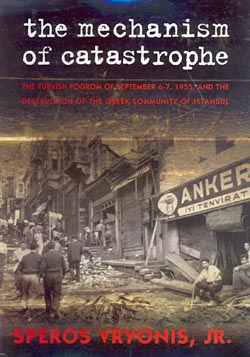

Of course, the government was involved, says Vryonis, as the 1960 and 1961 trials at Yassiada proved in their brief consideration of the matter. Contemporary newspaper and eyewitness reports (which the book provides) also describe government assistance given to pogromists during the riots as their organizers shouted “Cleanse the fatherland of the infidel!” and “We do not want infidels' merchandise in our country.” Official vehicles also transported the pogromists after they had finished their grisly work.

But while Menderes and several of his ministers were hung, they lost their lives for violating Turkey's constitution, not the destruction they wrought on its Greek and other non-Muslim citizens. For these crimes, not a single man was punished, according to Vryonis. 

The Islamization set in motion via discriminatory laws and violence, before and during the pogrom, has continued ever since, with constant pressure on the non-Muslim communities. Having lost everything, the Greek community began to emigrate. In 1964, the Turkish junta forced a very large number to leave or turn over their businesses to Turks within a certain number of hours, says Vryonis. They were taxed, though they were leaving, and their accounts were blocked. Furthermore, intermarriage between Greek citizens and Turkish Greeks was taxed when all marital property was decreed to belong to the “settlers” —making it easier to confiscate.

Today, the Greek residents of Turkey, mostly in Istanbul, number only about 1,800, according to Vryonis, and property rights continue to be so much a concern that the European Union is pressuring Turkey to implement legal changes. Of course, these are cosmetic at best.

"The society has already declared that the identity of Turkey is Islamic,” explains Vryonis. M. Hakan Yavuz discusses the situation in Islamic Political Identity in Turkey. The state apparatus tried to enforce Kemalism, limiting the power of Islam, albeit not insofar as minorities are concerned. “But the Turkish version of Islam is undergoing a revitalization which has successfully challenged [secularism],” says Vryonis. “Most of the provincial universities, for some time, have had major student organizations that are Islamic, that are not recognized by the authorities, but the authorities in the provinces are often Islamists.” 

Indeed, the majority of Turks are believing Muslims, a factor that emerged after the 1994 elections, when the Islamist Welfare Party won landslides in the mayoral elections in Asia Minor. Vryonis questions how the military can continue to bar Islamists from entering the officer corps. “It may be that has already happened,” he adds, “the dam has already broken and we don't know. Once that happens the show is over.” 

This matters, since the U.S. has armed Turkey so mightily. It has “the largest military establishment in the Middle East, Africa and Western and Northern Europe,” Vryonis says. “They have a big advantage when it comes to the buildup of tanks, jets, and this involves updating the armaments in Cyprus. The question is into what hands will all of this fall?”  

The answer was perhaps previewed in 2003 when the Turkish government refused to allow the disembarkment of 62,000 American troops to open a front in northern Iraq. In Iran, Vryonis points out, U.S. weapons fell into the hands of the Khomeiniites when the Shah fell. 

As to whether Kemalists are inherently all Muslims, Vryonis cannot assess the psychology of each person. “But if you look at the example in Iran, they executed the chiefs of Savak, and told the other ones to stay ...and watch what they were doing.” Within the Turkish government, he says, groups are said to have split, some working closely with Russia, others with China, and still others focusing on the European Union. 

A final issue concerns the Islamic army itself, Vryonis says. “[It] is not a homogeneous entity. [Islamists] tend to win elections by attracting people who are dissatisfied with this or that or the other,” says Vryonis. Even Prime Minister Recep Tayyip Erdogan, “in order to survive, wears about 4 or 5 or 6 masks. One is for the European Union, one is for Greece, and that changes, another is over the Israeli Palestinian issue another is for the military.... The state department never solved these problems.” But clearly, Vryonis says, Islamists “want a powerful Turkey and they want it to be more powerful than it is now.” 

The lesson to be taken from the 1955 pogrom is that little, if anything, has actually changed in Turkey. 

NOTES

[1] Vryonis Jr., Speros, The Turkish State in History: Clio Meets the Grey Wolf (1993 ed), p. 67.
[2] Vryonis Jr. Speros, The Turkish State in History, pp. 57-78.
[3] Sulzberger, C.L., “Ankara tax raises diplomatic issues,” New York Times, Sept. 12, 1943, p. 46.
[4] Ibid.
[5] “The Turkish minorities,” New York Times, Sept. 17, 1943. p. 20.

Alyssa A. Lappen is a former Senior Fellow of the American Center for Democracy, former Senior Editor of Institutional Investor, Working Woman and Corporate Finance, and former Associate Editor of Forbes. Her website is www.AlyssaaLappen.org.

Thursday, September 9, 2010

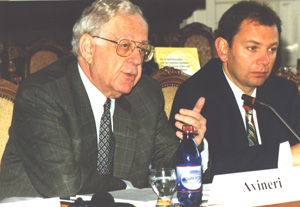
An article by Shlomo Avineri right after the rejection of the Annan Plan by Greek Cypriots in April 2004

From Fanoulla Argyrou's archives, an article by Professor Shlomo Avineri, written in 2004, right after the rejection of the Annan Plan by the Greek Cypriots. As Mrs Argyrou noted, Professor Avineri was one of the very very few foreign writers to explain to the world why we the Greek Cypriots were justified in rejecting the "Annan Plan". And said that "... In a united Europe, Greek Cypriots would not have freedom of movement in their own country - they would be ghettoed"..


article in "Financial Times"
28 April, 2004
by Shlomo Avineri


The Greek Cypriots' overwhelming rejection of the United Nations plan for the reunification of Cyprus should not come as a surprise. In the international media, the plan by Kofi Annan, UN secretary-general, had been presented as a fair-minded and well-intentioned compromise. The Greek Cypriots would regain some territory and a "Swiss-like federation" would reunify the island.

But this is not the way it looked to most Greek Cypriots in the south. To them it appeared that the UN and the European Union were bent on legitimising at least some of the consequences of the Turkish invasion of 1974, because the EU wanted to take the Cyprus issue off the table in order to facilitate negotiations on Turkey's accession to the EU.

Although the Annan plan in its various versions - the last one filled 9,000 pages - has not been fully translated into either Greek or Turkish, most of its outlines were, of course, known. But while outside observers focused mostly on the territorial and constitutional aspects suggested by the plan, for most Greek Cypriots the plan not only failed to answer their concerns but also seemed to be contrary to both UN and EU norms and values.

While some Turkish-occupied territory would be returned to Greek Cypriot rule, the contours of the Turkish Cypriot region would still reflect the outcome of Turkey's military invasion of 1974. Only half of the 200,000 Greek Cypriot refugees uprooted by the Turkish invasion would be able to return to their former homes. The rest would not be able to return, or be entitled to adequate compensation.

Most of the Anatolian Turks who have been settled in the north by the Turkish occupation authorities would remain. Turkish forces would also stay in the north until Turkish accession to the EU - an arrangement the Greek Cypriots would consider an infringement of their sovereignty. The UN and the EU, which, justly, oppose the Israeli occupation of the West Bank and Jewish settlements in the occupied territories, appeared to reward Turkish occupiers and settlers in the Cyprus case.

Last but not least, Greek Cypriots would not be able to move freely or settle in the Turkish north. This last prohibition rattled Greek Cypriots most because it meant that in a united Europe, where every EU citizen would be more or less free to take up residence and work in the Turkish part of Cyprus, Greek Cypriots would not have freedom of movement in their own country. In a way, the Greek Cypriots would have been ghettoised.

The failure to win approval for the Annan plan has wider ramifications. It shows that there are limits to what massive international pressure can accomplish when at least one of the participants in a dispute feels that its concerns have not been adequately dealt with.

Even well-intentioned plans cannot be first worked out by outside powers and then rammed down the throats of recalcitrant parties, whether in Cyprus or Bosnia, Kosovo or Kashmir, or in the Israeli-Palestinian conflict. When there is no local political will, outside pressure is not strong enough to achieve a workable solution. In such cases, conflict management is preferable to unrealistic outside schemes for conflict resolution.

The Greek part of Cyprus will enter the EU on May 1 under difficult conditions. Much wisdom and restraint will now be needed from both the EU and the Greek Cypriots. The EU, while obviously disappointed, should respect the sovereign will of the Greek Cypriot majority. The referendum, after all, was suggested by the international community and the EU expressed willingness to accept the Greek part of Cyprus even if reunification was not achieved by the accession date. To be vindictive now against the new member - Cyprus, albeit truncated - would be a political mistake and a moral failure on the part of the EU.

As for the Greek Cypriots, they should be careful not to translate their decision into triumphalism. Specifically, they should not view their successful accession to the EU as a licence for trying to bar EU negotiations with Turkey about future membership. On the contrary, like the Greek government, they should now advocate and support EU membership for Turkey.

This would be not only be magnanimous and politically astute, it might also be the only way towards a united Cyprus in the future, under conditions more acceptable to the Greek Cypriots and more in tune with international norms and values.

Shlomo Avineri: Turkey's frontline foreign policy

Journalist Fanoulla Argyrou comments: I would be grateful if you would kindly circulate the following comment to all those who received the article below. A very good analysis of Turkish intentions by Professor Avineri, as always. Back in April 2004 Professor Shlomo Avineri published an article in the Financial Times in London (on 28th April 2004 to be exact) titled "Realities behind the failure over Cyprus". He was one of the very very few foreign writers to explain to the world why we the Greek Cypriots were justified in rejecting the "Annan Plan". And said that "... In a united Europe, Greek Cypriots would not have freedom of movement in their own country - they would be ghettoed"...


by Shlomo Avineri, Professor of Political Science at Hebrew University, Director-General of Israel's Foreign Ministry in the first cabinet of Yitzhak Rabin
article in "In Depth", Volume 7, Issue. 4
Cyprus Center for European and International Affairs, University of Nicosia


A few months before he became Turkey’s foreign minister, Ahmet Davutoglu, then Prime Minister Recep Tayyip Erdogan’s chief adviser, met with a group of Middle Eastern academics and policy experts, including Arabs and Israelis. With his academic background and immense erudition, he succeeded in painting, on a wide canvass, the new directions of Turkey’s policies under the Justice and Development Party (AKP) leadership.
 
By then, it had become clear that Turkey’s road to the European Union had been closed, somewhat rudely, owing mainly to combined German and French pressure. But those who expected Islamist fire and brimstone from Davutoglu were deeply disappointed.
 
What was articulated was a levelheaded and sophisticated exposé, seldom heard from policymakers: it was thoughtful, honest, and breath-taking. It was also a clear departure from the conventional foreign-policy straightjacket devised by Kemal Ataturk, which had for decades forced Turkish diplomacy into the Procrustean bed of 1920’s-style integral nationalism.
 
Davutoglu began conventionally, declaring that Turkey’s geopolitical situation would always dictate the country’s foreign policy. Then came the bombshell: contrary to the conventional Kemalist view of the One and Indivisible Turkish Nation, Davutoglu referred to what everyone has known since modern Turkey was created: the country has more Azeris than Azerbaijan, more people of Albanian origin than live in Albania, more people of Bosniak origin than live in Bosnia, and more Kurds than in Iraqi Kurdistan.
 
This reality, Davutoglu maintained, means that violence and instability in Turkey’s immediate neighborhood threatens to spill into Turkey itself, and regional external conflicts can easily become internally disruptive. Hence the credo of Turkish foreign policy should be “zero conflicts with our neighbors and in our neighborhood.”
 
This, he explained, was the reason that Turkey was trying to find an accommodation with Armenia. It justified Turkey’s policy vis-à-vis the Kurdish Regional Government in Northern Iraq, its involvement in Bosnia and in Kosovo, its rapprochement with Syria, and also its attempt to mediate between Syria and Israel.
 
Turkey, he argued, is neither pro-Israeli nor pro-Syrian: it seeks an Israeli-Syrian accommodation in order to add another building block to regional stability. All these steps are taken by the AKP government because it is in Turkey’s interest, given not only its geopolitical position, but also its unique multi-ethnic structure (he didn’t use that terminology, though the implication was clear).
 
Since then (Davutoglu became Foreign Minister in May 2009), much of what Turkey has done can be explained as being in line with this “zero conflicts” theory, including a slightly more nuanced policy on the Cyprus issue. Yet recent developments suggest that, if this policy is pushed to its limits, it stumbles on its own premises.
 
One can well understand a Turkish policy of trying to defuse tensions with Iran over that country’s nuclear program. But the joint Iranian-Brazilian-Turkish initiative goes beyond such a policy.
 
Brazil’s President Luiz Inácio Lula da Silva may have stepped on a hornets’ nest, owing to his unfamiliarity with regional policies and his general anti-Yanqui sentiments. Erdogan must have known that, by trying in this way to shield Iran, he is opening a wider chasm with the EU – and obviously with the United States. Opposing new sanctions against Iran in the Security Council further alienated Turkey from both the EU and the US. This does not sit well with a “zero conflict” policy.
 
The same can be said about the shrill tone that Turkey, and Erdogan himself, has recently adopted vis-à-vis Israel. Walking off the stage at Davos during a round-table debate with Israel’s President Shimon Peres might have gained Erdogan points in the Arab world, which has historically viewed Turkey with the suspicion owed to the old imperial ruler. But the vehemence with which he lashed out at Israel during the Gaza flotilla crisis obviously went far beyond (justified) support for beleaguered Palestinians and (equally justified) criticism of the messy way in which Israel dealt with an obviously difficult situation.
 
While gaining support on the so-called Arab street, and perhaps upstaging Iranian President Mahmoud Ahmedinejad in the role of a modern Commander-of-the-Faithful, Erdogan’s policy and behavior have shocked not only Israelis, but also moderate Arab leaders in Egypt, Saudi Arabia, Jordan, and some of the Gulf states.
 
For many years, the AKP appeared to many in the region and elsewhere as a model for a democratic party with Islamic roots. But by supporting Hamas, Erdogan has allied Turkey with the most disruptive and extremist fundamentalist force in the Muslim Arab world – an organization that has its origins in the Muslim Brotherhood, the arch-enemy of all Arab regimes in the region (including, of course, Syria).
 
Since Erdogan is a critic of Israel, Arab rulers cannot say this openly. But Arab governments – and their security services – are beginning to ask themselves whether Turkey’s policies will undermine whatever internal stability their states possess.
 
This is the exact opposite of a genuine “zero conflict” policy that aims to minimize tensions and enhance stability. Turkey now finds itself, through its alliance with Iran and support for Hamas, rushing headlong into a series of conflicts – with Europe, the US, Israel, and moderate Arab regimes that have survived Iranian Shia fundamentalism but may now feel threatened by a neo-Ottoman Sunni foreign policy.
 
Turkey is thus emerging not as a regional mediator, equidistant from contending local players, but as an assertive, if not aggressive, regional power aiming for hegemony. Far from avoiding conflicts and mediating existing tensions, Turkey under the AKP appears intent on stoking new conflicts and creating new frontlines.

Saturday, July 24, 2010

Reply to the Telegraph's Damien McElroy's lies about "pogroms against Turkish-Cypriots"

We copy here the letter sent to the British newspaper 'Telegraph' and journalist Damien Mc Elroy by the Efylakas.com Editorial Team. As you will read yourselves, McElroy's blatant lies are just to much to swallow. 

Nevermind him referring to the military occupied part of Cyprus as if it is a legal entity, forgetting completely about the ethnocide of the Greek-Cypriots, he even makes the false assertion (without providing ANY evidence whatsoever) that the Greek-Cypriots have carried out "pogroms" against Turkish-Cypriots, when in fact the opposite happenned! Mr McElroy, with 200,000 Greek-Cypriot refugees until this day, 37% of the land occupied and people still missing and unaccounted for, its not the Greek-Cypriots who carried the pogroms, its the Turkish state!

 The Efylakas article can serve as an excellent template for you to add your own arguments. 

Please make sure you send your copy, undersigned with your name,  telephone number and address (they will remain confidential), to dtletters@telegraph.co.uk and telegrapheditorial@telegraph.co.uk. Remember to be polite and respectful. 

P.S. - Mr. Damien McElroy seems to be writing from and based "in Keryneia". With what legal status exactly is this gentleman writing from an illegally occupied EU territory? What is this British citizen (?) doing by working and writing from an area that the government of the UK does not recognize?


For publication - "Right of Reply"The Editor: 'The Daily Telegraph' and Mr. Damien McElroy 
July 24, 2010

Dear Sir,

Our news site (efylakas.com) is being read by hundreds of Greeks and Greek-Cypriots everyday. In those readers there there are also members of the enormous Hellenic Diaspora in Britain, where Greeks and Greek-Cypriots live assimmilated and in peace and contribute economically, spiritually, socially and culturally, with respect their host country and British ethics and traditions. With this letter, we believe that we represent the views of a large majority of those readers.


We outreach to you as people who take great pride and have tremendous passion in human rights, dignity, and respect to justice and the common European values of democracy and the rule of law, and as such we respectfully request that you take into consideration our objectios regading an article of yours on Cyprus, and therefore publishing our letter.

We refer to your report of 20th July 2010 (anniversary of the illegal Turkish invasion)  titled
“Northern Cyprus plans to become Mediterranean 'Las Vegas'” by Damien McElroy and wish to comment as follows:

1. There is no “Turkish enclave” in Cyprus, but part of the Republic of Cyprus under Turkish illegal military invasion and occupation since 1974. The Republic of Cyprus is the
only recognized legal entity on the island of Cyprus.

2. The “Cratos Hotel” you are referring to has been
illegally built on stolen land in the occupied village of Kazafani in the Kyrenia district. The land rightfully belongs to the Church of Cyprus, and has been taken away by violence in the summer of 1974.

3. A UN embargo forbidding recognition of the occupied regime is confirmed by Security Council Resolutions 541 (1983) and 550 (1984) because it is the outcome of a brutal and illegal invasion and continued occupation and there is no question of it being recognised. It is sustained by the presence of approximately 45,000 mainland Turkish military forces, and there has been at least 160,000 illegal Turkish settlers (brought in mainly by the Anatolian regon of mainland Turkey), which constitutes a war crime, as confirmed by International Law and European court decisions.


4. There is no hope of so called independent future for the occupied area. The area under question is stolen from the 200,000 Greek Cypriot refugees forced by the Turkish invading army to abandon their properties at gunpoint back in 1974, and to this day not allowed to return and use their property.


5. You cannot call “sharing” the abandonment of your stolen property and half of your country. Stolen land and properties have to be returned to their rightful and legal title deed owners. What the Turks are asking the Greek-Cypriots in an unprecedented audacity is to hand them over their stolen properties! Mr McElroy, we ask you: Would you give your house's title deed away to the first thief that forces you out of it?


6. This is an enormous lie that can't possibly be corroborated by any evidence. There were no pogroms against the Turkish Cypriots in 1974. In fact, the British Labour government of Harold Wilson and Turkish PM Bulent Ecevit literally conspired (and declassified Foreign Office documents prove this) to let Turkey invade the island and fulfill a long awaited Turkish-British plan to divide the island. That was finally agreed during their meeting in London on 17th July 1974. Furthermore, the  British High Commissioner in Cyprus,  Sir Olver and the then Turkish Ambassador in Nicosia confirmed in writing (British Foreign Office released documents refer) that NOT A SINGLE TURK was harmed by the Greek short lived coup which ONLY affected the Greeks and not the Turks. The only "evidence" of attacks against Turkish-Cypriots happenned at the villages of Aloa and Santalari which happenned by terrorists of EOKA-B' which was against the Makarios government, and even that happenned during the invasion, while Turkey was ethnically cleansing the north of Cyprus by 200,000 Greek-Cypriots, and not before the invasion happenned as Mr. McElroy falsily says! We demand that Mr McElroy produces any evidence he has that the Greek-Cypriots conducted organized "pogroms" against Turkish-Cypriots, or else he will prove that he is not a very objective journalist.


7. The 5,000 Britons who have bought properties in the occupied that belong to Greek-Cypriot refugees have done wrong and violated human rights and international law in dealing with stolen properties and will have to bear the consequences.


8. As for Mr. Day, former Conservative MP, living in the occupied area of Cyprus he has no right whatsoever to speak on the matter, the colonial jurisdiction over Cyprus has ended many years ago. Britain, the government of which is currently run by a Conservative-Liberal coalition, does not recognized the Turkish-occupied part of Cyprus as a "state". What is, therefore, Mr. Day really doing out there, and does he represent British interests and the sacred British values of rule of law and democracy in this way?


Thank you.


With all due respect,

Editorial Team / efylakas.com
Telephone number:
+442034114439
Original article follows:  

Wednesday, July 21, 2010

Daniel Pipes: Turkey in Cyprus vs. Israel in Gaza, Ankara's recent condemnation of Jerusalem is hypocritical


Source: Washington Post, 19 July 2010
Daniel Pipes
source: http://www.washingtontimes.com/news/2010/jul/19/turkey-in-cyprus-vs-israel-in-gaza/print/

In light of Ankara's recent criticism of what it calls Israel's "open-air jail" in Gaza, today's date, which marks the anniversary of Turkey's invasion of Cyprus, has special relevance.

Turkish policy toward Israel, historically warm and only a decade ago approaching full alliance, has cooled since Islamists took power in Ankara in 2002. Their hostility became explicit in January 2009, during the Israeli-Hamas war. Prime Minister Recep Tayyip Erdogan grandly condemned Israeli policies as "perpetrating inhuman actions which would bring it to self-destruction" and even invoked God ("Allah will ... punish those who transgress the rights of innocents"). His wife, Emine Erdogan, hyperbolically condemned Israeli actions as so awful they "cannot be expressed in words."

Their verbal assaults augured a further hostility that included insulting the Israeli president, helping sponsor the "Freedom Flotilla" and recalling the Turkish ambassador.

This Turkish rage prompts a question: Is Israel in Gaza really worse than Turkey in Cyprus? A comparison finds this hardly to be so. Consider some contrasts:

c Turkey's invasion of July-August 1974 involved the use of napalm and "spread terror" among Cypriot Greek villagers, according to Minority Rights Group International. In contrast, Israel's "fierce battle" to take Gaza relied on only conventional weapons and entailed virtually no civilian casualties.

c The subsequent occupation of 37 percent of the island amounted to a "forced ethnic cleansing," William Mallinson said in a just-published monograph from the University of Minnesota. In contrast, if one wishes to accuse the Israeli authorities of ethnic cleansing in Gaza, it was against their own people, the Jews, in 2005.

c The Turkish government has sponsored what Mr. Mallinson calls "a systematic policy of colonization" on formerly Greek lands in Northern Cyprus. Turkish Cypriots in 1973 totaled about 120,000 people; since then, more than 160,000 citizens of the Republic of Turkey have been settled in their lands. Not a single Israeli community remains in Gaza.

c Ankara runs its occupied zone so tightly that, in the words of Bulent Akarcali, a senior Turkish politician, "Northern Cyprus is governed like a province of Turkey." An enemy of Israel, Hamas, rules in Gaza.

c The Turks set up a pretend-autonomous structure called the "Turkish Republic of Northern Cyprus." Gazans enjoy real autonomy.

c A wall through the island keeps peaceable Greeks out of Northern Cyprus. Israel's wall excludes Palestinian terrorists.

And then there is the ghost town of Famagusta, where Turkish actions parallel those of Syria under the thuggish Assads. After the Turkish air force bombed the Cypriot port city, Turkish forces moved in to seize it, thereby prompting the entire Greek population (fearing a massacre) to flee. Turkish troops immediately fenced off the central part of the town, called Varosha, and prohibited anyone from living there.

As this crumbling Greek town is reclaimed by nature, it has become a bizarre time capsule from 1974. Steven Plaut of Haifa University visited and reports: "Nothing has changed. ... It is said that the car distributorships in the ghost town even today are stocked with vintage 1974 models. For years after the rape of Famagusta, people told of seeing light bulbs still burning in the windows of the abandoned buildings."

Curiously, another Levantine ghost town also dates from the summer of 1974. Just 24 days before the Turkish invasion of Cyprus, Israeli troops evacuated the border town of Quneitra, handing it over to the Syrian authorities. Hafez Assad chose, for political reasons too, not to let anyone live in it. Decades later, it too remains empty, a hostage to bellicosity.

Mr. Erdogan claims that Turkish troops are not occupying Northern Cyprus but are there in "Turkey's capacity as a guarantor power," whatever that means. The outside world, however, is not fooled. While Elvis Costello recently pulled out of a concert in Tel Aviv to protest the "suffering of the innocent [Palestinians]," Jennifer Lopez canceled a concert in Northern Cyprus to protest "human rights abuse" there.

In brief, Northern Cyprus shares features with Syria and resembles an "open-air jail" more than Gaza does. How rich that a hypocritical Ankara preens its moral plumage about Gaza even as it runs a zone significantly more offensive. Instead of meddling in Gaza, Turkish leaders should close the illegal and disruptive occupation that for decades has tragically divided Cyprus.

Daniel Pipes is director of the Middle East Forum and a visiting fellow at Stanford's Hoover Institution.

Sunday, July 11, 2010

Letter to all MEPs: In 9th of July of 1821 we had in Cyprus the massacre by Turks, of 486 notable Greek Cypriots

We copy a letter Euripides Billis, Ex – Assistant Professor of the National Technical University of Athens (NTUA). Says a lot about the history of Turkish brutality on Cyprus. 

Make sure you use the letter and distribute it, as it contains important facts about the history of Cyprus and Turkish brutality.  


Honorable Members of the European Parliament,

In 1821 we had the Greek revolution against Turks.

This year in 9th of July of 1821 we had in Cyprus the massacre by Turks, of 486 notable Greek Cypriots.

Even the fact that in the island of Cyprus there existed that time calm, the Turk governor of Cyprus Mehmet Küçük asked from the Sultan Mahmud II (1785-1839) his permit to kill 486 notable members of Cyprus Greek community so as Greek people of Cyprus to remain without leaders.

Of course the permit was given the 486 Greek Cypriot were then Killed.

Between them were included, the archbishop of Cyprus Kyprianos and all the Bishops of Cyprus. The archbishop of Cyprus Kyprianos was hanged and all the others were massacred.

If you ever been in Nicosia you may see in the yard of Madonna Phaneromeni church the mausoleum of the hanged archbishop Kyprianos and of massacred Bishops of Cyprus.

This was the kind of Ottoman Turkish Empire for which the foreign minister of Turkey Davoutoglou stated many times recently how "ideal" was.

As you may below see, every date is an anniversary of Turkish massacres in different countries of the late Ottoman Turkish Empire.

The written below data are from the George Horton (late Consul of US in Smyrna until its destruction by Turks in 1922) book "The Blight of Asia" which you may find in Google.

Turkey beyond these data continued until recent years its genocides against Greek in Constantinople in 1955 and 1963, against the Greek people of Imvros and Tenedos islands and against Greek Cypriots during its invasion in Cyprus in 1974. Of course for many years continues the killing of Kurds.

This is the European Turkey.

May I also remind you that the prime minister of Turkey Erdogan will visit as a "conqueror" the occupied part of Cyprus in 20th of July to celebrate their crime of the of Turkish invasion in Cyprus in 1974 

Euripides Billis
Ex – Assistant Professor of Athens National Technical University of Athens (NTUA)


ATTACHMENT: George Horton's data about Turkish massacres from 1822 up till 1904

Tuesday, July 6, 2010

Big success! The Guardian: Jennifer Lopez criticised over Cyprus gig

Big success for the campaign and the activists. Congratulations to the Cyprus Action Network of America! The campaign has gained important momentum and credibility after this, and this article by the respected British newspaper The Guardian should be distributed widely. 

Please post the link to the article on your Facebook walls, Twitter and in blogs. 


Source: 'The Guardian' 05 July 2010
Author: Helena Smith

http://www.guardian.co.uk/world/2010/jul/05/jennifer-lopez-northern-cyprus-gig

 Singer Jennifer Lopez may have given it little thought when she accepted a seemingly innocuous invitation to celebrate her 41st birthday in northern Cyprus.

The deal: a sun-soaked stay en famille at a $220m destination described as the "single biggest hotel project both sides of the island" in exchange for a one-off performance to celebrate its opening.

But on the Island of Love, where memories of war are never far removed, the star appears to have walked into a political minefield. Instead of eliciting hot anticipation, the visit has ignited the sort of controversy that no celebrity needs.

Cyprus was invaded in 1974 by Turkish troops in response to an attempted coup by the Greek junta in Athens, and has been divided between Greeks in the south and Turks in the north ever since. It remains one of the world's most intractable disputes, where almost every action is seen through a political lens.

A web campaign led by indignant Greek Cypriots to convince Lopez to change her mind has attracted thousands of signatories angry that she should even consider performing in territory that is not officially recognised by the United Nations.

"It is with dismay and shock that the people of Cyprus and especially the Greek Cypriot women in the Republic of Cyprus and elsewhere in the world heard the news that you intend to attend the inauguration of a hotel in the occupied by Turkey [sic] part of our native country," says a letter that forms the basis of the campaign.

The missive, carried on the Cyprus Action Network of America, argues that nearly four decades after the island was "barbarically invaded" it would be morally unconscionable for the artist to visit.
To add insult to injury, campaigners say the hotel in Kyrenia will open on 20 July, exactly 36 years since Turkish paratroopers were dropped onto the island's central plain.

"The Turks go to a great length to secure support from people like you in order to promote their political ambitions and objectives. Does your charitable work and status permit you to give credibility to Turkish rapists, thieves, invaders, occupiers of our stolen properties," the letter asks.

Despite the furore, the five-star Cratos Premium insists the event will go ahead, promising a "very special birthday party … full of surprises for Jennifer Lopez".

But opposition is mounting. An estimated 7,000 people have signed up to a Facebook campaign – and it shows no sign of letting up.

Sunday, July 4, 2010

Turkish soldier's testimony: The massacre of about 100 Greek Cypriot civilians who had fled to the small village of Mora in 1974

,Article to be circulated and syndicated. Yet another testimony of Turkish atrocities in Cyprus. 
An interview with Mustafa Organ, a Turkish soldier serving in the 48th Ankara/Tsoumbouk artillery brigade at the time of the Turkish invasion of Cyprus.


Source: Frankfurt-based newspaper 'Ozgur Politica', 28 January 1998
Organ referred to the massacre of about 100 Greek Cypriot civilians who had fled to the small village of Mora, near Nicosia.'Those killed at the exit of the village were women, children and pensioners who were running for their lives', he said.'The little streets and the exit areas were full of civilian pensioners and small children who were trying to get away. These people were killed in the most vicious way and some of the bodies were cut to pieces. The bodies were lying in the scorching heat for a week. Later officers told us we had to hide the bodies. I drove a bulldozer. Others dug a large and wide ditch and buried them. Soldier Efket Avcioglu from Mara? was also a witness to the event'.

Organ referred also to prisoners being killed and robbed and Greek and Turkish Cypriot women and girls being raped by Turkish officers and soldiers.'I cannot forget a tall dark officer from Adana who raped a 13 year old Greek Cypriot girl, and the rape of two Turkish Cypriot girls near the Nicosia industrial zone', he said.

It can be said that all the human rights safeguarded by international conventions were violated by Turkey in Cyprus. The European Court of Human Rights and the Human Rights Commission of the Council of Europe have established that many crimes were committed in Cyprus by Turkish troops, such as cold-blooded murders, rapes, enforced prostitution, torture, inhuman treatment etc. By committing those crimes intentionally and on a mass scale, Turkey is answerable for war crimes and/or crimes against humanity. Having in mind the 1948 United Nations Convention on the Prevention and Punishment of the Crime of Genocide, together with relevant judgments of international courts, Turkey's conduct towards the Greek Cypriot population in the occupied area of Cyprus should be considered as an act of genocide. Large-scale killings of both conscripts and civilians, cold-blooded murders, deliberate infliction of serious bodily and mental harm, all directed against Greek Cypriots simply because of their ethnic origin, race and religion, constitute a genocide according to international law.

A Greek-Cypriot refugee writes to J-Lo: Why lend your good name to the oppressors, exploiters and butchers of the world? Jennifer PLEASE don't go!

Article to be circulated and syndicated. Post link to Facebook, Twitter.


by Petros Evdokas
source: Cyprus Indymedia, 01 July 2010


Jennifer PLEASE don't go!

The location of this place is my mother's and grandfather's village named Ayios Epiktitos (Άγιος Επίκτητος). It was illegally invaded in 1974 and ethnically cleansed by force of all its native and indigenous hellenic people.

It is still occupied today - illegally.

The invaders gave it a new name (a further violation of the Geneva Convention), razed most of our traditional adobe homes to the ground and is now building glitzy glamor social "hot" spots, along with casinos, brothels, money laundering and illegal tourist operations.

Hundreds of my cousins, uncles and relatives from Ayios Epiktitos have been forced into exile and now live as refugees spread all over the globe. The Turkish military does not allow us to return to live there - everyone else in the world is invited by the regime for illegal tourism and to settle on our stolen lands except our own people, even though these have been our peoples' traditional homelands for thousands of years.

Every other stone you kick over while walking, building or cultivating the land in our country reveals a statue, a shard of pottery, an antiquity site documenting and tracing the continuity of civilization in Cyprus for more than ten thousand years... until now. The custodians and keepers of that civilization, the native people of the land, have been expelled from there by force, by murder and violence.

I barely survived that invasion myself. One of my last memories of Ayios Epiktitos as I fled the area with my father and other family friends running for our lives, is the image of the olive groves extending from the edge of the village to the main road and then all the way down to the sea. By the side of the road and in between the olive trees were overturned tractors and trucks on fire, trucks upside down with the wheels still spinning, and the fertile cultivated land strewn with dead bodies. These were the last defenders of the village, blown to bits, burned, strafed and machine-gunned to death protecting the entrance to Ayios Epiktitos from the invading enemy troops. Some of them were my schoolmates; some of them will just be forever unknown: the faces of those who died so that I may live.

Forcibly chased away from our homes and homelands our people have become refugees, activists and freedom fighters... by necessity. We see that you have a sensitivity for social causes, especially around Feminist values, which by definition are against war, slaughter, racism, ethnic cleansing and genocide. We ask for your kindness, your solidarity, your understanding.

Why lend your good name to the oppressors, exploiters and butchers of the world?

Jennifer PLEASE don't go!

Petros Evdokas, petros@cyprus-org.net
http://CyprusIndyMedia.org
and
http://petros-evdokas.cyprus-org.net/Another-sort-of-Introduction.html
~~~~~~~~~~

Military Occupation, Ethnic Cleansing and Genocide:
http://www.kypros.org/Occupied_Cyprus/epiktitos/

Wartime: Missing Persons from Ayios Epiktitos:
http://www.missing-cy.org/cgi-bin/missing/display_origin?orc=0&or1=Ayios+Epiktitos


* Friends, please feel free to distribute, publish, email and post this letter far and wide, wherever you think it is appropriate to do so. Thank you.

AGAINST JENNIFER LOPEZ PERFORMING IN OCCUPIED CYPRUS
http://www.facebook.com/pages/AGAINST-JENNIFER-LOPEZ-PERFORMING-IN-OCCUPIED-CYPRUS/129154837124167?v=wall


Letter to J-Lo by the president of the Cyprus Movement of Refugees & Displaced Mothers [Article to be circulated]

Article to be circulated. Post link to Facebook, Twitter.

The article below was sent Mrs. Jennifer Lopez directly both via fax and email by Mrs. Markella Isaia-Chakka, president of the Cyprus Movement of Refugees & Displaced Mothers. So far neither Jennifer Lopez, or anyone from her team has replied either to refugee women Mrs. Isaia-Chakka or Fanoulla Argyrou. 


 ATTENTION OF:   Mrs. Jennifer Lynn Lopez (born July 24, 1969)
Dear Mrs. Lopez,  

I write to you as the President of the Displaced Mothers of Cyprus, as a woman and as a mother above all. From this part of the world we have been watching and admiring your successful career, but also your amazing strength in raising your children and determination in offering them the right values in life. 

However, we were really saddened and shocked when we heard that you will visit the occupied by the Turkish troops area of the Republic of Cyprus and take part in the celebrations for the anniversary of the unlawful invasion of Turkey to our country which has deprived us of our homes and of our basic human rights within our own country. Since July 20th, 1974, when Turkey invaded our island, one third of the population of the island of Cyprus  that is 200,000 people - probably the largest proportion of Internally Displaced Persons/Refugees in a single country – have been forcibly expelled from their homes and 37% of the sovereign territory of the Republic of Cyprus has come under Turkish military occupation. Ever since the massive displacement, Greek Cypriots have been prevented from returning to their homes and properties against all United Nations’ Resolutions and all Decisions of the European Court of Human Rights condemning Turkey for its unlawful presence on the island. 

The displaced people, who in effect became refugees in their own country, suffered not only the loss of their properties and belongings, but also the loss of their beloved ones, some of whom are still missing with Turkey denying to report on their fates. Members of our movement, who were teenagers at the time, were raped by Turkish soldiers and were captured as prisoners of war - the rest of us were raped psychologically and still suffer.

Turkey has uprooted our childhood and our dreams, yet we do not lose our faith.  We now have our own families and children and struggle to raise them with our limited means away from our homes. BUT WE DO NOT FORGET the TRAGEDY of the 20th of July 1974.

On your website you say that “I, myself, am Catholic,” (Lopez told Southern Florida’s NBC 6); we would like to inform you that this past June His Holiness Pope Benedict the 16th visited the Republic of Cyprus, but refused to visit the occupied by the Turkish troops areas ignoring an “official” invitation to do so.  This should say a lot about what this “state” represents to Christianity and humanity. As Christians ourselves, and as women who have suffered by the atrocities of Turkey, we urge you not to make this trip to Cyprus and not to take part in these celebrations. The fact that you are a world-famous celebrity makes this “birthday party” a very well-camouflaged trap on behalf of Turkey, the consequences of which will have a direct negative impact on my country and us, as the Turkish propaganda is using you in an attempt to purchase a false “normalcy” and false “legitimacy” for the bandit pseudo-state that is recognized by no-one but Turkey.
When You Make Your Decision, PLEASE have in mind THAT:
  • On July 20th 1974 Turkey invaded and is still occupying a part of Cyprus, and hence Europe itself,
  • Turkey perpetrated ethnic cleansing and war crimes against Greek Cypriots,
  • We, the Internally Displaced Mothers and Refugees demand Restoration of our Human Rights and a Safe Return to our HOMES and PROPERTIES, 
  • We demand the determination of the fate and whereabouts of the missing persons and the accountability of Turkey.

These facts are the truth which is often so tactfully omitted in discussions about Cyprus and ignored by the World Leaders who present themselves as the Protectors of Human Rights. As a woman, a mother and a Christian yourself we ask you to respect our sufferings and not celebrate your birthday along with the looters of our history, of our past, of our present and of our future. We count on your sensitivity against the violation of human rights throughout the world and we would like to ask for your active support in our fight against imperialism and in our efforts to restore our human rights, the same way you actively fought to raise awareness about the Mexican women murdered in Ciudad Juarez and Chihuahua. I am personally willing to provide all the information you might need in an objective manner and co-operate with you in every possible way in order to inform the world about these unpunished crimes held in Cyprus since 1974. We trust you will make the right decision.

I am looking forward to your reply.

 Yours sincerely,
Markella Isaia-Chakka
President


CYPRUS’ MOVEMENT OF REFUGEES & DISPLACED MOTHERS
for the restitution, conferment and respect of their fundamental human rights and their children’s

ΚΙΝΗΣΗ ΠΡΟΣΦΥΓΩΝ & ΕΚΤΟΠΙΣΜΕΝΩΝ ΜΑΝΑΔΩΝ

για την πλήρη αποκατάσταση, διασφάλιση και σεβασμό των βασικών ανθρωπίνων δικαιωμάτων αυτών και των παιδιών τους

P.O.Box 27540 – 2430 Eghomi – Nicosia, Cyprus

Tel: +357 99419317, +357 22667333, Fax: +357 22673074

email: info@mitrogonia.com Registration No.: 2907


OF UTMOST IMPORTANCE

July 2, 2010
Mrs. Cara Lewis
William Morris Agency , LLC.
1325 Avenue of the Americas
New York , NY
Fax: 212-903-1531